
Parallelization and Supervision
Context-Based Multi-Threading
Contexts provide OS-level thread isolation for stream processing. Each context runs on a dedicated thread with a single-threaded Tokio runtime, eliminating lock contention within a context.
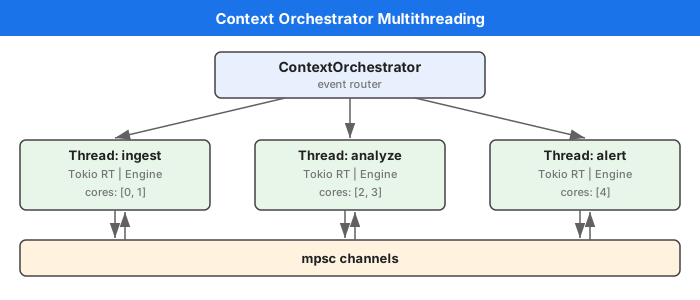
context ingest (cores: [0, 1])
context analyze (cores: [2, 3])
context alert (cores: [4])

stream RawEvents = Sensor
    .context(ingest)
    .emit(context: analyze, data: data)

stream Stats = RawEvents
    .context(analyze)
    .window(1m)
    .aggregate(avg: avg(value))
    .emit(context: alert, avg: avg)
Key properties:
- No shared state: All state is thread-local within a context
- Bounded channels: Cross-context communication via
mpscchannels with backpressure - CPU affinity: Optional pinning to specific cores (Linux only, via
core_affinity) - Zero overhead: Programs without
contextdeclarations run single-threaded
See the Contexts Guide for a full tutorial.
Worker Pool Parallelization Model

Partitioning Strategies
| Strategy | Description | Use Case |
|---|---|---|
| consistent_hash | Stable key hashing | Order guarantee per key |
| round_robin | Equal distribution | Load balancing |
| broadcast | Send to all workers | Enrichment, reference data |
Order Guarantees
- Per partition: Strict order guaranteed
- Global: Approximate order via event timestamps
Planned Features
The following features are parsed by VPL but not yet evaluated at runtime:
Parallelization via Contexts
Use contexts for multi-threaded execution with CPU affinity:
context fast_lane (cores: [0, 1])

stream OrderProcessing = Orders
    .context(fast_lane)
    .partition_by(customer_id)
    .where(quantity > 0 and price > 0)
    .emit(order_id: id, total: price * quantity)
Note:
.concurrent()and.on_error()are reserved syntax that is not implemented, and the engine now says so instead of accepting it: loading a program that uses.concurrent()fails with.concurrent() is not yet implemented — use .partition_by() with \--workers N`, or a `context` block, for parallelism, andvarpulis checkreports E090. Use contexts and.partition_by()` for parallelism.
Automatic Supervision (Planned)
Restart policies, circuit breaker, and health checks are designed but not yet implemented:
- Restart policies:
always,on_failure,never - Exponential backoff
- Circuit breaker (closed → open → half-open)
- Exactly-once semantics via checkpointing + idempotence